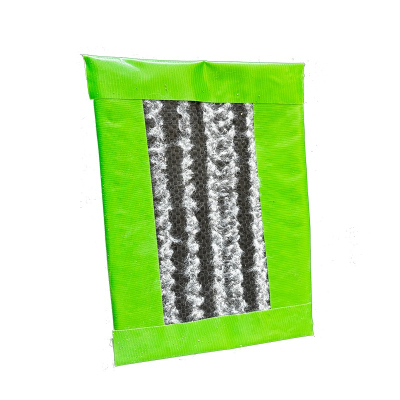
Geotextile 350g m²: Specification Guidance for Heavy-Duty Infrastructure
A port expansion project in Ringaskiddy, Ireland, required a geotextile that could survive underwater rock placement. Large armour stone would be dropped onto the fabric from height. Lighter materials had failed in similar conditions. The engineers specified a thick needle-punched nonwoven geotextile with high puncture resistance. The Geotextile 350g m² weight class would have met those demands.
For procurement teams and civil engineers, Geotextile 350g m² represents a mid-to-heavyweight nonwoven fabric that balances strength, puncture resistance, and water flow. This specification appears frequently in coastal protection, landfill liner systems, and roads built over soft ground.
 |  |  |
Market Position of 350g m² Geotextiles
The global geotextile market reached USD 8.54 billion in 2023 and is projected to reach USD 14.68 billion by 2032, growing at 6.2% annually . Nonwoven Geotextile products account for roughly 67% of total consumption. Heavier weight grades, including 350g m², show faster growth than lighter grades because infrastructure projects demand higher puncture resistance and longer service lives.
Geotextile 6 Metres wide rolls have gained popularity for large-scale installations. A 6m wide roll at 350g m² contains more material per roll than a 2m or 3m width. Fewer rolls mean fewer field seams. Fewer seams mean lower labor costs and fewer potential leak points.
Technical Properties of Geotextile 350g m²
Mechanical Specifications
A quality Nonwoven Geotextile at 350g m² typically delivers:
1.Thickness: 2.2 to 2.8 mm
2.Grab tensile strength: 9 to 12 kN/m (both directions)
3.CBR puncture resistance: 1.5 to 2.2 kN
4.UV retention after 500 hours: 70% or higher
5.Permittivity: 0.8 to 1.2 sec⁻¹
6.Apparent opening size: 0.07 to 0.21 mm
The CBR puncture value for Geotextile 350g m² runs roughly two to three times higher than a 200g m² product. This difference determines whether a fabric survives sharp aggregate or rock placement.
Roll Configurations
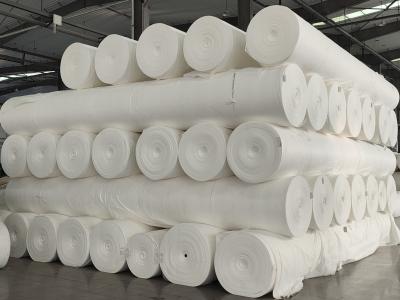
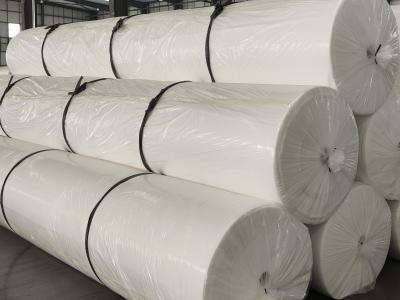
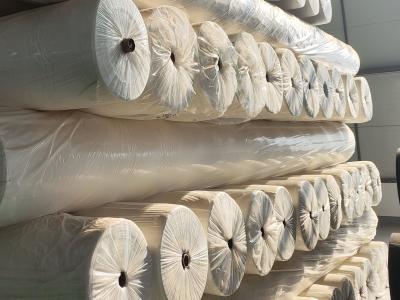
Standard roll widths range from 1m to 6m. Geotextile 6 Metres wide rolls require special orders from many manufacturers but deliver measurable installation savings. Covering a 30m-wide area with 6m rolls takes five rolls and four field seams. Using 2m rolls takes fifteen rolls and fourteen seams. The labor difference is substantial.
Roll lengths typically run 50m to 100m per roll. A Geotextile Membrane 100m roll at 350g m² in 2m width weighs roughly 70 kg. The same roll in 6m width weighs about 210 kg, requiring mechanical handling.
Manufacturing Process
The spunbonded needle-punch method produces most Nonwoven Geotextile at this weight grade.
Virgin polypropylene pellets feed into an extruder and melt. The molten polymer passes through spinnerets to form continuous filaments. These filaments get drawn to orient molecular structure, increasing tensile strength. The filaments then lay onto a moving belt to form a uniform web.
For Geotextile 350g m², multiple web layers are cross-lapped (folded) to reach target weight. The web then passes through a needle loom where thousands of barbed needles punch through thousands of times per minute. The barbs carry fibers through the web, mechanically entangling them into a stable three-dimensional mat.
This process creates the bulky structure that gives Nonwoven Geotextile its filtration and drainage capabilities. Carbon black (2-3%) is compounded into the polymer before extrusion for UV stabilization.
Application Categories
Coastal and Marine Protection
The Ringaskiddy Port project used rock armour placed below water. The specified geotextile had to prevent sub-soil loss while surviving stone impact. A fabric comparable to Geotextile 350g m² was installed using a rebar frame that allowed mechanical lowering, eliminating diver work. The 6m width minimized underwater joints.
Roads Over Soft Subgrade
When building roads on weak or saturated ground, Geotextile 350g m² placed between subgrade and aggregate prevents material mixing. The high puncture resistance ensures survival under aggregate dumping and compaction equipment.
Landfill Liner Systems
In landfill applications, 350g m² nonwoven geotextiles serve as protection layers over geomembranes. The fabric cushions the liner from puncture by overlying drainage stone while filtering leachate.
Railway Ballast Stabilization
Railway tracks need separation between sharp ballast and soft subgrade. Geotextile 350g m² offers sufficient strength for dynamic train loading while maintaining water permeability.
Procurement Considerations
Testing Requirements
Request Mill Test Reports showing results from accredited labs. Key tests include:
1.Grab tensile strength (ASTM D4632)
2.CBR puncture resistance (ASTM D6241)
3.UV resistance (ASTM D4355)
4.Permittivity (ASTM D4491)
5.Apparent opening size (ASTD D4751)
Width Selection
For projects covering large areas, specify Geotextile 6 Metres wide rolls. Confirm availability with suppliers before finalizing specifications. Some manufacturers stock only 2m and 3m widths, requiring custom production for 6m.
UV Stabilization
Verify carbon black content between 2% and 3% and confirm dispersion quality. Products without proper UV stabilization lose strength rapidly when exposed before burial.
Frequently Asked Questions
Q1: What projects need Geotextile 350g m² instead of lighter fabric?
Choose Geotextile 350g m² when the job requires high puncture resistance from sharp aggregate, rock placement, or heavy construction traffic. Applications include coastal protection under rock armour, landfill liner protection layers, roads over soft subgrade, and railway ballast stabilization. For basic separation under light traffic, 150-200g m² works fine.
Q2: What are the advantages of Nonwoven Geotextile at this weight?
Nonwoven Geotextile provides better filtration than woven alternatives because water flows in multiple directions. The fabric also offers higher elongation for conforming to uneven ground and better puncture resistance distribution. Woven geotextiles give higher tensile strength in specific directions but lower water flow.
Q3: What roll widths are available for 350g m² geotextile?
Standard widths run from 1m to Geotextile 6 Metres. Stock widths commonly include 2m, 3m, 4m, 5m, and 6m, though availability varies by manufacturer. Wider rolls reduce field seams. For large projects, specify Geotextile 6 Metres to cut installation labor.
Q4: How should I specify Geotextile 350g m² for coastal work?
For marine applications, specify: virgin polypropylene fibres with 2-3% carbon black for UV stability, minimum CBR puncture resistance based on rock weight and drop height, Geotextile 6 Metres width to reduce underwater joints, and documented durability data from similar installations.
Q5: What ASTM tests apply to Geotextile 350g m²?
Key ASTM tests include D4632 for grab tensile strength, D6241 for CBR puncture, D4355 for UV resistance, D4491 for permittivity, and D4751 for apparent opening size. Always request Mill Test Reports showing results for each production lot.
Conclusion
The Geotextile 350g m² weight class serves demanding infrastructure applications where lighter materials fail. From coastal protection to landfill liner systems, this Nonwoven Geotextile provides the puncture resistance and filtration efficiency engineers require.
For large-area projects, Geotextile 6 Metres wide rolls reduce field seams and installation time. Partner with manufacturers who provide certified test data and documented quality systems.
Need help specifying Geotextile 350g m² for your next project? Share your application details with our technical team. We will provide a no-obligation review of appropriate weight grades and roll widths with certified performance data.