



Geotextile 300gsm: What the Lab Data Actually Says About Performance
If you have ever watched a 200gsm fabric tear during aggregate placement, you know the sinking feeling. The crew stops. The stone gets pulled back. The schedule slips. The question that follows is always the same: “What weight should we have used?”
For a lot of projects, the answer lands on Geotextile 300gsm. But the weight number alone does not tell you whether the fabric will perform. Two 300gsm fabrics from different suppliers can behave very differently. The difference comes down to polymer chemistry, fiber structure, and how the material holds up under load. Let us look at what the research and field data actually show.
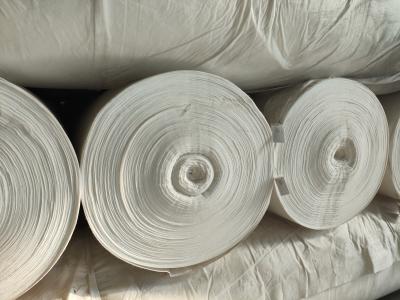 | 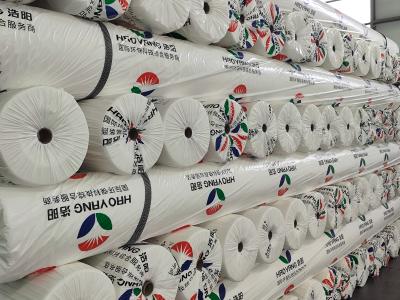 | 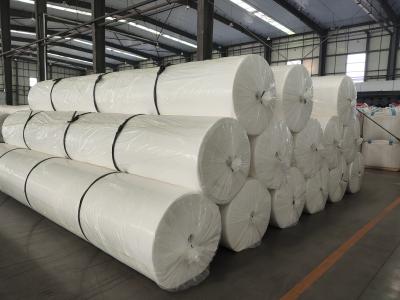 |
What the CBR Puncture Data Reveals
The most direct measure of installation survivability is CBR puncture strength, tested per ASTM D6241 . A 50mm probe presses into the fabric until it ruptures. The force required tells you how the fabric will handle sharp aggregate.
A study from the Wisconsin Department of Transportation compared puncture test results across multiple nonwoven geotextiles . The CBR puncture loads for the materials tested ranged from 594 to 665 pounds, with an average of 620 pounds and a coefficient of variation of just 5% . That low variation matters. It means the test is repeatable, and the results are a reliable indicator of field performance.
For a Geotextile 300gsm, the CBR puncture strength typically falls in the 1.5 to 2.2 kN range, depending on manufacturing quality . That is roughly 50% higher than a 200gsm fabric, which often lands around 1.0 kN. The difference is not linear with weight. It comes from increased thickness and fiber entanglement density at the higher weight.
Why does this matter in the field? A 2019 study published in the Transportation Research Record examined geotextiles exhumed from a Virginia road after 23 years of service . One key finding: the geotextile reduced particle breakage caused by abrasion under transient loads. The fabric acted as a cushion, absorbing point stresses that would otherwise fracture aggregate particles and create fines . Higher puncture resistance means the fabric survives installation with its cushioning function intact.
The Filtration Problem That No One Talks About
Puncture resistance gets the attention. Filtration clogging is the quieter failure mode.
A 2025 study in the Journal of Rock Mechanics and Geotechnical Engineering examined needle-punched nonwoven geotextiles used around drain pipes in fine tailings . The researchers built a radial flow apparatus to simulate real drainage conditions. They tracked hydraulic conductivity over time and analyzed the clogging mechanism using scanning electron microscopy.
The results were sobering. Hydraulic conductivity decayed exponentially with time under different flow conditions. Particles smaller than 30 microns migrated to the drain pipe under seepage forces. A dense, thick cake layer formed upstream of the geotextile filter .
The clogging process moved through three stages: pore blockage and initial cake formation, dynamic growth of the filter cake, and finally cake layer filtration . In the third stage, the geotextile itself became almost irrelevant. The filter cake controlled everything.
For Geotextile 300gsm in drainage applications, this research carries a clear message. The apparent opening size of 0.07 to 0.21mm matters, but it is not the only variable. The fabric thickness and fiber structure determine how quickly the cake forms and how much flow capacity remains after it does. A heavier fabric with more thickness provides a larger buffer zone before the cake becomes the dominant resistance.
The study also found that backwash cleaning could recover about 60% of the original hydraulic conductivity by removing the filter cake from the geotextile surface . That is a practical consideration for projects where maintenance access is possible.
Polymer Choice Under Chemical Stress
The filtration research used needle-punched nonwovens in fine tailings, where chemical conditions can be aggressive . This brings up a question that often gets overlooked: polypropylene or polyester?
A study on filtration compatibility of clay-nonwoven geotextiles under normal stress tested both needle-punched and heat-bonded fabrics . The researchers found that normal stress significantly affected filtration performance. Needle-punched nonwovens, the type used for Geotextile 300gsm, demonstrated better soil filtration and water permeability compared to heat-bonded alternatives .
Polymer chemistry determines chemical resistance. Polypropylene handles pH 2 to 13, covering acidic mine leachate, alkaline soils, and landfill leachate. Polyester offers higher tensile strength but can hydrolyze in extreme pH conditions. For Mine Nonwoven Geotextile applications, where leachate is often acidic, polypropylene is the standard choice.
The Pond Liner Problem: Floating and Puncture
For Fish Pond Liner applications, Geotextile 300gsm serves as an underlayment. Its job is to cushion the geomembrane from puncture by roots, rocks, or sharp subgrade. The filtration function also allows trapped water to drain.
A two-year study published in the North American Journal of Aquaculture tested porous geotextile liners in small earthen ponds . Two liner types were installed: one with 0.090mm openings and one with 0.355mm openings. The liners did not tear or decay during the study, and they prevented erosion of pond bottoms compared to unlined control ponds .
But there was a catch. The liners with 0.090mm openings floated up into the water column in all three test ponds. The other liner floated in one pond . The researchers attributed the floating to gas accumulation beneath the fabric or density differences between the liner and water.
For pond liner underlayment, this study suggests that Geotextile 300gsm with its 0.07 to 0.21mm opening range occupies a middle ground. It provides erosion protection and puncture cushioning without the extreme fine-pore structure that promoted floating in the test. The heavier weight also adds dimensional stability, making it less likely to shift or lift during installation.
The study authors concluded that if the floating problem could be solved, porous geotextiles should be given further consideration for erosion control in small ponds . For projects where the underlayment will be covered by the geomembrane and ballast, floating is less of a concern.
What to Verify Before You Buy
The research points to specific checks that matter more than the weight number on the label.
CBR puncture strength. Request test data per ASTM D6241 . For Geotextile 300gsm, expect at least 1.5 kN. Lower values indicate either a lightweight fabric or poor fiber entanglement.
Apparent opening size. Confirm the O90 falls between 0.07 and 0.21mm. This range balances soil retention with permeability for most applications.
Normal stress performance. For drainage applications, ask how the fabric performs under confining pressure. The filtration study showed that normal stress significantly affects performance . Needle-punched nonwovens maintain better permeability under load than heat-bonded alternatives.
Polymer match. For acidic or alkaline environments, specify polypropylene. For neutral pH and higher tensile requirements, polyester is an option.
Thickness. A Geotextile 300gsm should measure approximately 2.2 to 2.4mm . Thinner fabric claiming the same weight may have lower puncture resistance and less cushioning capacity.
Frequently Asked Questions
Q1: What applications require Geotextile 300gsm instead of lighter or heavier grades?
Choose Geotextile 300gsm for road subgrade separation, mining filtration, pond liner protection, and drainage systems where moderate puncture resistance and tensile strength are needed. Lighter grades (150-200gsm) suit basic separation and landscaping. Heavier grades (600-1000gsm) handle landfill liner protection and heavy haul roads with sharp aggregate.
Q2: What is the advantage of nonwoven over woven geotextile at 300gsm?
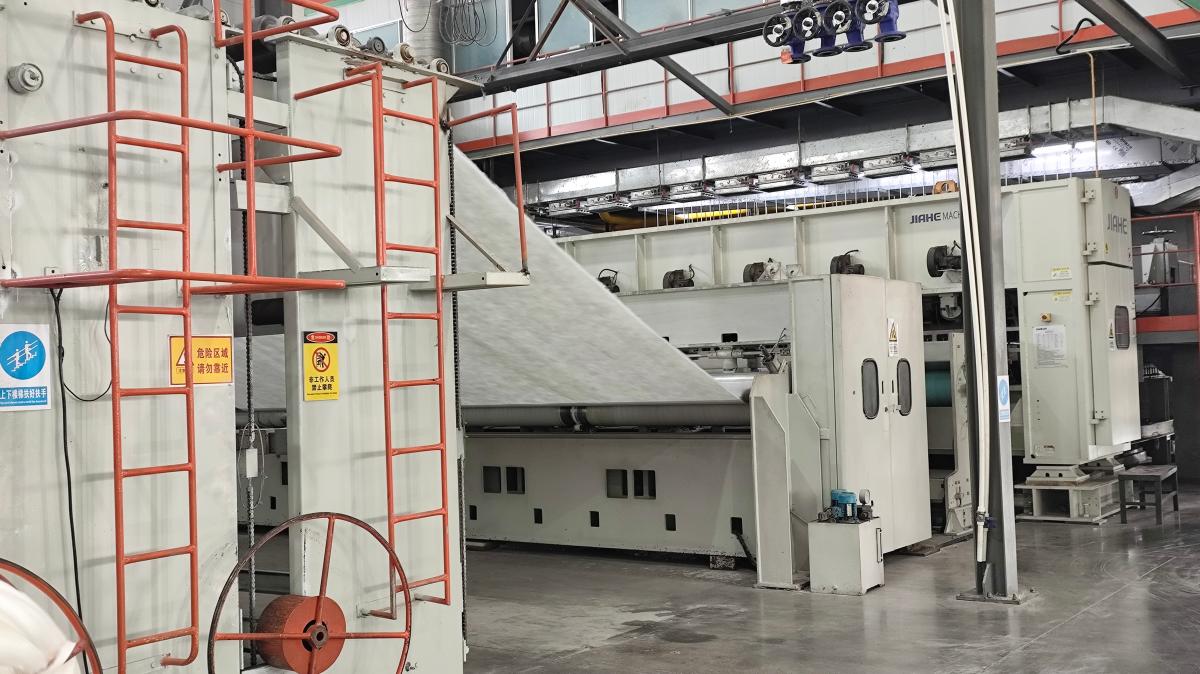
Nonwoven Geotextile 300gsm is made through needle-punching, creating a three-dimensional structure with high permeability and excellent filtration. It is preferred for separation and drainage. Woven geotextiles offer higher tensile strength for reinforcement but lower permeability. For most road and drainage jobs, nonwoven is the correct choice.
Q3: Can Geotextile 300gsm be used for Mine Nonwoven Geotextile applications?
Yes. The Mine Nonwoven Geotextile segment frequently specifies 300gsm for filter cloth in heap leach pads and tailings facilities. Polypropylene-based fabrics offer chemical resistance across pH 2 to 13, ensuring performance in acidic mining environments.
Q4: How does Geotextile 300gsm perform in Fish Pond Liner applications?
In Fish Pond Liner installations, 300gsm nonwoven geotextile serves as a protection layer beneath the liner. It cushions the geomembrane from puncture by sharp subgrade materials and provides filtration. The 1.5 kN CBR puncture resistance offers adequate protection for most pond liner applications.
Q5: How should buyers specify Geotextile 300gsm for quality assurance?
Specify: needle-punched nonwoven construction from 100% virgin PP or PET fibers with UV stabilizers; minimum weight of 300gsm; minimum grab tensile strength of 9.5 kN/m; minimum CBR puncture of 1.5 kN; permittivity meeting drainage requirements; and UV resistance of at least 70% strength retention after 500 hours. Request Mill Test Reports for each production lot confirming these values.
The Bottom Line
Geotextile 300gsm is not just a weight grade. It is a performance specification that only holds up when the CBR puncture resistance, apparent opening size, and polymer chemistry match the application. The research shows that needle-punched nonwovens at this weight provide better filtration under load than heat-bonded alternatives . They resist clogging longer because the filter cake forms more gradually . And they cushion geomembranes effectively in pond liner applications .
But none of that matters if the delivered fabric weighs less than specified or lacks proper UV stabilization. Verify the numbers. Check the Mill Test Reports. Match the polymer to the chemical environment.
Need help specifying Geotextile 300gsm for your next project? Share your application details with our technical team. We will provide a no-obligation review of appropriate specifications with certified performance data.


