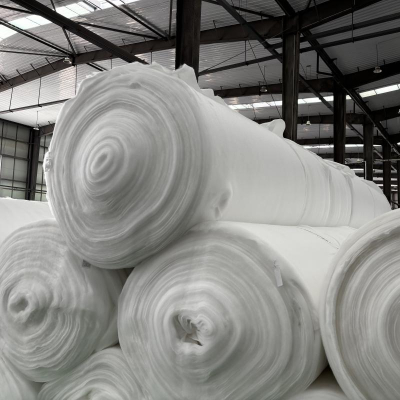
Geotextile 200g m2: The Balanced Specification for Separation, Filtration, and Drainage
A copper mining operation in South America faced a recurring challenge with their heap leach pad drainage system. The geotextile filter layer needed to maintain permeability while preventing fine ore particles from clogging the drainage network. After testing several specifications, engineers selected a Geotextile 200g m2 nonwoven fabric. The material provided the filtration performance required while offering sufficient puncture resistance to survive installation under sharp ore.
This outcome reflects what field experience and research have consistently demonstrated. The Geotextile 200g m2 weight class offers an optimal balance of strength, permeability, and cost-effectiveness for a wide spectrum of civil engineering applications—from road construction to Mine PP Geotextile applications in heap leach pads and tailings facilities.
 |  |  |
What Geotextile 200g m2 Delivers in Practice
The Geotextile 200g m2 specification refers to fabric weight—200 grams per square meter. A quality nonwoven PP Geotextile at this weight typically offers grab tensile strength of approximately 6.5 kN/m in both directions, CBR puncture resistance around 0.9 kN, and thickness of roughly 1.7 mm . The apparent opening size falls between 0.07 and 0.21 mm, providing effective filtration while maintaining permeability .
These properties translate directly to field performance. For a mining application, the tensile strength of a Mine PP Geotextile at 200g m2 determines whether the fabric remains intact under construction traffic. The puncture resistance determines whether the fabric survives when sharp ore or aggregate gets dumped onto it. The opening size determines whether fine soil particles wash through or get trapped.
PP Geotextile materials are manufactured from polypropylene, a polymer that offers density of 0.91 g/cm³—significantly lighter than polyester alternatives (1.38 g/cm³) . This means more coverage area per roll at equivalent weight, reducing shipping costs and simplifying handling.
Manufacturing: How 200g m2 Geotextile Is Produced
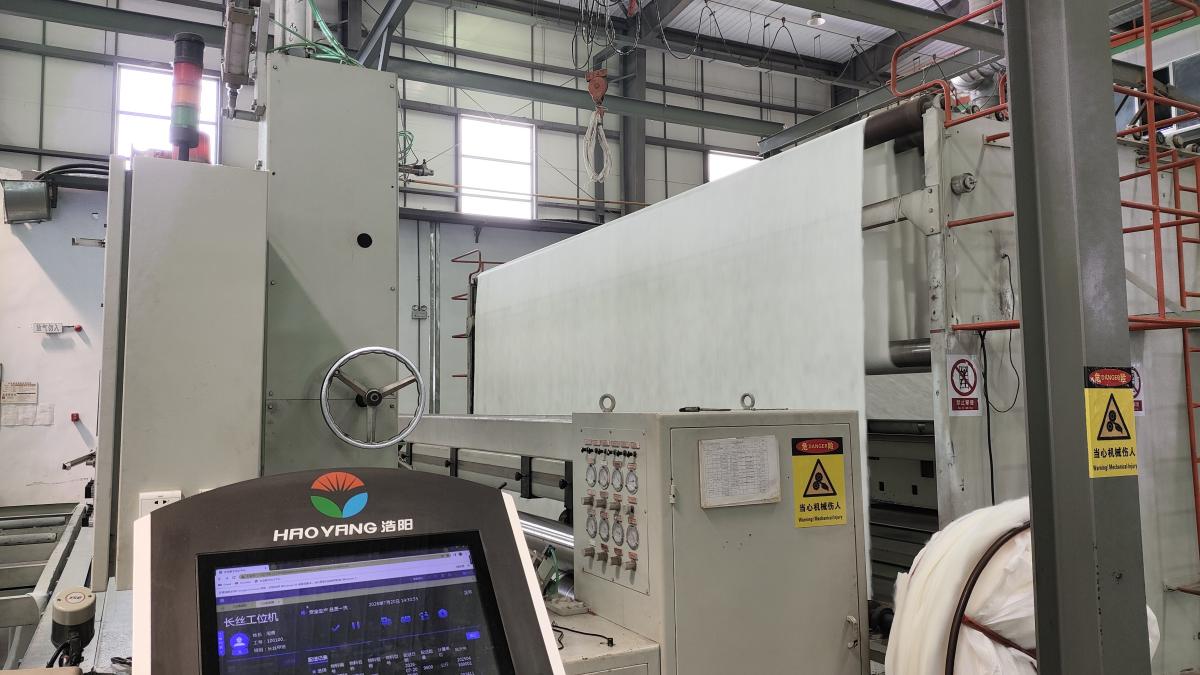
The production of Geotextile 200g m2 follows the spunbonded needle-punching process, which transforms polymer pellets directly into finished fabric in a single continuous operation . Polypropylene chips feed into a screw extruder and melt at temperatures of 160-280°C. The molten polymer passes through a filter and spinneret to form continuous filaments. These filaments are cooled, drawn by high-speed airflow, and laid into a uniform web.
The web then passes through a needle loom where thousands of barbed needles punch through at high frequency, mechanically entangling fibers into a stable three-dimensional structure . This one-step process eliminates intermediate steps required for staple fiber production—bundling, stretching, cutting, packing, carding—resulting in lower production cost and higher product consistency.
The resulting fabric has a stable porous structure with excellent water permeability and filtration capabilities. The mechanical entanglement creates isotropic properties—similar strength, permeability, and filtration in all directions. Polypropylene offers excellent acid and alkali resistance across a pH range of 2 to 13, making it ideal for long-term interactions with alkaline materials like cement, fly ash, and lime . In complex environments like landfills, it maintains stability without undergoing hydrolysis.
Applications for Geotextile 200g m2
Road and Railway Construction
In road construction, Geotextile 200g m2 placed between subgrade and aggregate base prevents intermixing, maintains structural integrity, and extends pavement life . The fabric separates layers while allowing water to drain, preventing pore pressure buildup that would weaken the road. For railways, the fabric provides separation between sharp ballast and soft subgrade, reducing maintenance requirements.
Mining Heap Leach Pads
In mining operations, Mine PP Geotextile at 200g m2 serves as filter cloth in heap leach pads and tailings facilities . The chemical resistance of polypropylene (pH 2-13) ensures performance in acidic mining environments. The fabric maintains flow rates under sustained exposure to process solutions while preventing fine ore particles from clogging the drainage system.
Landfill and Environmental Containment
Nonwoven PP Geotextile at 200g m2 protects geomembranes from puncture in landfill liner systems while providing filtration for leachate collection . The material's chemical stability ensures long-term performance in aggressive environments without degradation.
Drainage and Filtration Systems
The porous structure of nonwoven Geotextile 200g m2 provides effective filtration while resisting clogging. The material's water repellency combined with efficient water conduction makes it ideal for drainage applications behind retaining walls and beneath pavements .
Geomembrane Protection
In landfill and pond liner systems, Geotextile 200g m2 cushions geomembranes from puncture by overlying drainage stone. The fabric's puncture resistance provides adequate protection for standard aggregate conditions . It is suitable for reservoirs, tunnels, landfills, and road construction.
What Buyers Should Check Before Ordering
Test Reports
Request Mill Test Reports for each production lot confirming key properties: grab tensile strength, CBR puncture resistance, UV resistance, permittivity, and apparent opening size . Quality PP Geotextile at 200g m2 should show consistent values across these tests.
Weight Verification
Confirm that delivered fabric meets the specified 200g m2 weight within tolerance. A fabric claiming 200g m2 but weighing less will not provide the expected mechanical properties .
UV Stabilization
If the fabric will sit exposed before burial, verify UV inhibitor content. Quality Geotextile 200g m2 includes carbon black or other stabilizers. Test results should show at least 70% strength retention after 500 hours.
Roll Width and Coverage
Standard roll widths range from 1m to 6m, with typical lengths of 50m to 100m . Wider rolls reduce field seams. For large projects, specify widths that match your planned coverage to minimize cutting and waste.
Frequently Asked Questions
Q1: What is the advantage of PP Geotextile at 200g m2 over polyester?
PP Geotextile offers lower density (0.91 vs 1.38 g/cm³), giving more coverage area per roll at the same weight . PP provides better alkali resistance across pH 2-13 and is hydrophobic, which helps drainage performance. It also resists acids, alkalis, and biological degradation.
Q2: What applications require Geotextile 200g m2 instead of lighter grades?
Choose Geotextile 200g m2 for road subgrade separation, mining filter cloth, drainage systems, and geomembrane protection. Lighter grades (100-150g) suit basic separation and landscaping. Heavier grades (300-400g) handle landfill liner protection and heavy reinforcement. For most road and mining drainage applications, 200g m2 provides the optimal balance.
Q3: Can Geotextile 200g m2 be used for Mine PP Geotextile applications?
Yes. The Mine PP Geotextile segment frequently specifies 200g m2 for filter cloth in heap leach pads and tailings facilities . The chemical resistance of polypropylene (pH 2-13) ensures performance in acidic mining environments, while the fabric maintains flow rates under sustained exposure to process solutions.
Q4: How should buyers specify Geotextile 200g m2 for quality assurance?
Specify: needle-punched nonwoven construction from 100% virgin PP fibers with UV stabilizers; minimum weight of 200g m2; minimum grab tensile strength; minimum CBR puncture resistance; permittivity meeting drainage requirements; and UV resistance of at least 70% strength retention after 500 hours. Request Mill Test Reports for each production lot confirming these values .
Q5: What are the standard roll dimensions for Geotextile 200g m2?
Standard widths range from 1m to 6m, with typical roll lengths of 50m to 100m . Width of 6m is available from many manufacturers, reducing field seams and installation time.
Conclusion
The Geotextile 200g m2 weight class provides reliable separation, filtration, and drainage performance for a wide range of infrastructure applications—from road construction to Mine PP Geotextile applications in mining operations. This PP Geotextile delivers the tensile strength, puncture resistance, and permeability that engineers require for moderate-demand applications.
When specifying Geotextile 200g m2, verify mechanical properties through Mill Test Reports, confirm UV stabilization for exposed installation periods, and select appropriate roll widths to minimize field seams.
Need help specifying Geotextile 200g m2 for your next project? Share your application details with our technical team. We will provide a no-obligation review of appropriate specifications with certified performance data.