80 Mil HDPE Liner: A Practical Guide to Specifications, Applications, and Global Sourcing Introduction
When a containment project involves aggressive chemicals, heavy loads, or long-term environmental liability, engineers turn to the thickest and most robust option in the HDPE range: the 80 Mil HDPE Liner. At 2.0 millimeters (80 mils), this heavy-duty geomembrane provides the puncture resistance, tensile strength, and durability required for the most demanding applications.
The market reflects this demand. The HDPE anti-seepage geomembrane sector grew from USD 1.75 billion in 2025 to USD 1.89 billion in 2026, a CAGR of 7.7%, and is projected to reach USD 2.51 billion by 2030 . Mining operations, hazardous waste landfills, and industrial containment projects are the primary drivers of this sustained growth.
So what do you need to know about 80 Mil HDPE Liner in 2026? This guide covers the technical specifications that matter, how the material performs in real-world conditions, and what to check before you place an order for HDPE Smooth Geomembrane products.
 |  |  |
What Is 80 Mil HDPE Liner and Why Specify It?
Definition and Core Properties
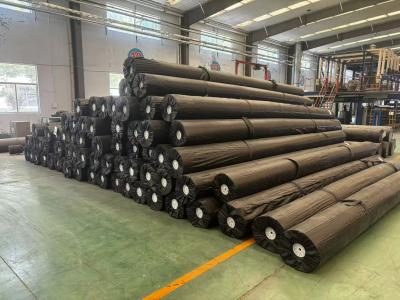
80 Mil HDPE Liner (2.0 mm) is a flexible, thermoplastic sheet manufactured from virgin high-density polyethylene resin blended with 2–3% carbon black and antioxidants. It is engineered as a high-strength impermeable barrier for long-term liquid, gas, and contaminant containment in demanding environments .
Key performance parameters per GRI-GM13 for 80 Mil HDPE Liner include:
Property | 80 Mil Requirement | Test Method |
| Thickness | 2.0 mm (80 mil) ±0.10 mm | ASTM D5199 |
| Density | ≥ 0.940 g/cm³ | ASTM D1505 |
| Tensile Yield (MD) | ≥ 29 kN/m | ASTM D6693 |
Tensile Break | ≥ 53 kN/m | ASTM D6693 |
| Elongation at Break | ≥ 700% | ASTM D6693 |
| Puncture Resistance | ≥ 640–960 N | ASTM D4833 |
| Tear Resistance | ≥ 249 N | ASTM D1004 |
Carbon Black Content | 2.0–3.0% | ASTM D4218 |
Stress Crack Resistance | ≥ 1,000–3,000 hours | ASTM D5397 |
| Permeability | ≤ 1 × 10⁻¹¹ cm/s | ASTM D5084 |
Source: GRI-GM13 specification; data from BPM Geomembrane and EFI USA
An HDPE Smooth Geomembrane meeting these numbers delivers 99.9%+ containment efficiency. For mining and landfill applications, the material must withstand aggressive solutions while maintaining mechanical integrity.
When to Choose 80 Mil Over Thinner Options
Compared to 40 mil (1.0 mm) or 60 mil (1.5 mm) liners, 80 Mil HDPE Liner offers:
Higher puncture resistance (640–960 N vs. 480 N for 60 mil)
Superior stress crack resistance (1,000–3,000 hours vs. 500 hours minimum for 60 mil)
Greater tensile strength at yield (29 kN/m vs. 22 kN/m for 1.5 mm)
For heap leach pads, hazardous waste cells, and industrial chemical containment, the extra thickness provides critical safety margins .
Technical Specifications — What the Standards Say
Material Composition
A specification-grade HDPE Geomembrane Liner at 80 mil starts with virgin HDPE resin, density controlled between 0.940 and 0.960 g/cm³. The additive package includes:
2–3% carbon black (20–40 nm particle size) for UV stabilization
Antioxidants to suppress thermal oxidation during processing and service life
Process aids to ensure uniform sheet formation and weldability
Carbon black dispersion must be A-1, A-2, or B-1 per ASTM standards. If the dispersion is not uniform, UV protection will be inconsistent, and the liner will age faster .
Smooth vs. Textured
HDPE Smooth Geomembrane offers distinct advantages for flat or gently sloped applications:
Superior weldability — uniform surface allows consistent thermal fusion welding
Lower material cost — 20–40% less than textured alternatives
Easier deployment — reduced friction during panel placement
For slopes exceeding 3H:1V (approximately 18 degrees), textured geomembrane is recommended. Textured sheet has a higher friction coefficient, which prevents slippage on steep slopes .
Manufacturing and Quality Assurance
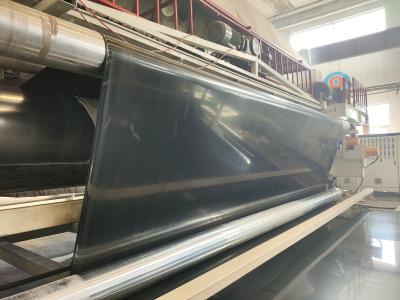
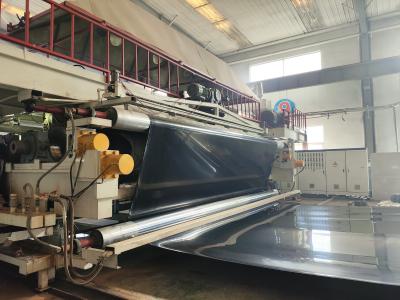
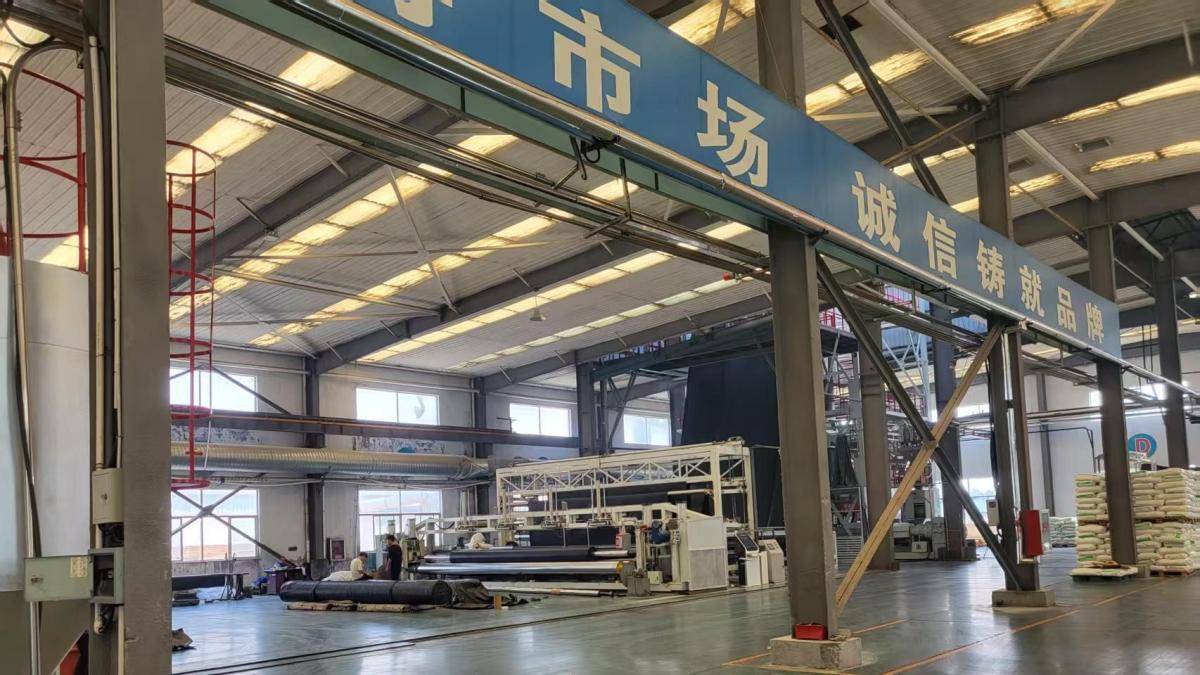
80 Mil HDPE Liner is manufactured through extrusion or blown film technology. The process involves:
Resin compounding — 95–98% HDPE blended with 2–3% carbon black and antioxidants
Extrusion — material heated to approximately 200°C and extruded through a die
Sheet forming — calibrated rollers control thickness; automatic systems maintain ±5% tolerance
Cooling and winding — tension-controlled roll formation
GRI-GM13 compliance ensures consistent quality. Key tests include tensile strength (ASTM D6693), puncture resistance (ASTM D4833), and stress crack resistance (ASTM D5397). OEMs like BPM Geosynthetics, GSE, and AGRU manufacture to these standards .
Real-World Applications and Case Studies
MacDill Air Force Base — Aircraft Fire Training Pond
A liner installation project at MacDill Air Force Base demonstrates the practical application of 80 Mil HDPE Liner in a critical containment setting. The COMANCO team installed approximately 7,200 square feet of 80 mil HDPE liner for a drainage area used to contain residue from an aircraft fire simulation unit .
The project included:
15 linear feet of batten bar around the central concrete outlet
A series of 6-inch, 7-inch, and 10-inch pipe boots to seal the containment area
Complete sealing to prevent residue from seeping into the environment
Chemical Facility — Conductive Liner Installation
A chemical facility in central Louisiana used GSE White HDPE 80 mil Conductive liner for a containment project. COMANCO installed 20,000 square feet of conductive liner along with two pipe boots. The conductive feature enables post-installation leak detection without excavation. The project was completed with spark testing to verify no defects in the liner system .
Landfill Applications — Lone Mountain Facility
Engineering calculations for a landfill cell design at a facility in Oklahoma documented the use of 80 mil HDPE liner for slope stability analysis. The unit weight of 80 mil HDPE liner is 0.39 lbs/ft², which engineers used to calculate tensile forces from wind loading, soil cover, and thermal contraction .
Mining and Heap Leach
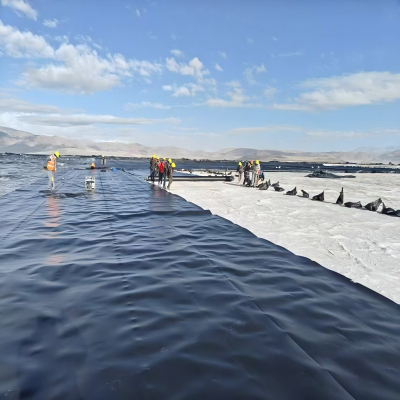
80 Mil HDPE Liner is widely used in mining operations for heap leach pads, tailings storage facilities, and process solution ponds. The material's chemical resistance and mechanical durability protect against acidic or alkaline solutions commonly used in mineral extraction .
Installation Best Practices for 80 Mil HDPE Liner
Subgrade Preparation
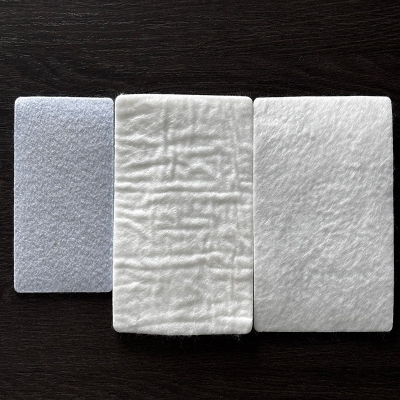
The foundation must be smooth, free of rocks exceeding 12 mm diameter, sticks, organic matter, and sharp objects. Compaction to ≥95% Proctor density is standard. For rough subgrades, a non-woven geotextile cushion (400–500 g/m²) or 300 mm sand cushion is recommended .
Seaming
Dual-track thermal fusion welding (hot wedge) is the preferred method for HDPE Smooth Geomembrane. Key parameters :
Welding temperature: 420–680°F (for hot air)
Extrusion die temperature: 428–536°F
Seam area must be dry and clean — moisture or dust compromises weld integrity
Seam strength must achieve 90–98% of parent material strength per ASTM D6392 .
Testing Protocols
Non-destructive testing of every seam via air pressure, vacuum box, or spark testing
Destructive sampling — minimum one sample per 300–500 feet of seam length
Trial welds required at start of each shift and after every four hours of continuous seaming
Environmental Restrictions
Field seaming is prohibited when ambient temperature is below 32°F (0°C), liner surface exceeds 158°F (70°C), during sustained winds over 20 mph, or during precipitation .
Selecting a Reliable Supplier for 80 Mil HDPE Liner
Your Checklist
When sourcing 80 Mil HDPE Liner, verify these essential items:
Certifications — GRI-GM13 or ASTM D7176 compliance with third-party validation. Reputable suppliers like BPM, GSE, and AGRU manufacture to these standards .
Material Traceability — 100% virgin resin from reputable suppliers (Dow, ExxonMobil, Borealis). Recycled content is not acceptable for primary containment.
Mill Test Reports — Lot-specific documentation showing actual test values for thickness, tensile strength, puncture resistance, carbon black content, and OIT .
Testing Capability — GAI-LAP accredited laboratory or third-party validation from SGS, Intertek, or Bureau Veritas.
Warranty — Minimum 20-year manufacturer warranty for 80 Mil HDPE Liner meeting GRI-GM13 standards.
Red Flags to Avoid
Unwillingness to provide lot-specific Mill Test Reports
Prices significantly below market without explanation
Vague answers about resin sources or additive packages
No third-party certifications
Carbon black content below 2.0% — indicates inadequate UV stabilization
Frequently Asked Questions
Q1: What does “80 Mil” mean in HDPE liners?
“80 Mil” refers to the liner's thickness — 80 thousandths of an inch, equivalent to approximately 2.0 millimeters. This thickness is ideal for heavy-duty applications requiring enhanced puncture resistance and long service life .
Q2: How long will an 80 Mil HDPE Liner last?
Properly manufactured and installed 80 Mil HDPE Liner with adequate UV stabilization demonstrates a service life of 75–120+ years when covered and 20–50 years for exposed applications. The carbon black content (2.0–3.0%) and antioxidant package are the keys to longevity .
Q3: What is the difference between smooth and textured 80 Mil HDPE Liner?
HDPE Smooth Geomembrane offers superior weldability, lower cost (20–40% less), and easier deployment for flat areas. Textured geomembrane provides approximately three times higher friction on slopes and is required for slopes exceeding 3H:1V (approximately 18 degrees) .
Q4: What certifications should an 80 Mil HDPE Liner meet?
Require GRI-GM13 certification with lot-specific Mill Test Reports. Key properties: density ≥0.940 g/cm³, tensile yield ≥29 kN/m, puncture resistance ≥640–960 N, carbon black 2.0–3.0%, and stress crack resistance ≥1,000 hours .
Conclusion: Pay for Performance, Not Just Price
The global market for 80 Mil HDPE Liner offers abundant supply at competitive price levels. The challenge for buyers is finding material that actually meets specifications. A low price is meaningless if the liner fails after five years.
Real-world projects demonstrate that success depends on verified performance: the MacDill Air Force Base project used 80 Mil HDPE Liner for critical aircraft fire training containment ; the Louisiana chemical facility installed 20,000 square feet of conductive 80 mil liner with spark testing ; and GRI-GM13 provides the industry-standard framework for quality assurance.
Professional buyers reduce risk through three actions:
Write specifications referencing recognized international standards (GRI-GM13, ASTM D7176)
Demand lot-specific Mill Test Reports before any material ships
Select suppliers who provide comprehensive test data, material traceability, and documented project references
The most cost-effective HDPE Geomembrane Liner is not the one with the lowest initial price, but the one that delivers verified performance throughout the project's design life.
Procurement Resource: Our 80 Mil HDPE Liner Technical Specification Template and Supplier Audit Checklist are available at no charge. These documents draw on field experience across landfill, mining, and industrial containment projects worldwide.
Contact our technical sales engineering team for a specification review, to request lot-specific Mill Test Reports, or to discuss project-specific HDPE Smooth Geomembrane requirements for your next inquiry.