2mm HDPE Liner: 2026 Market Review, Technical Standards, and Buying Advice
Introduction: When Projects Call for 2mm HDPE Liner
Not every containment job needs a thick liner. But when the waste is hazardous, the chemical bath is aggressive, or the site conditions are rough, engineers reach for 2mm HDPE Liner. This thickness (80 mil) sits at the sweet spot between flexibility for installation and brute strength for long-term service.
The numbers back up the trend. The global geomembrane market — where 2mm HDPE Liner plays a starring role in high-risk applications — is projected to grow from USD 2.23 billion in 2025 to USD 3.59 billion by 2034. That is a 5.46 percent CAGR . Thicker materials like 2.0 mm command premium prices because they use more resin and must pass tougher quality checks.
This report walks through current 2mm HDPE Liner pricing, technical specs, real project examples, and how to separate good HDPE geomembrane supplier from the rest.
 |  |  |
H2: Market Snapshot — Pricing and What Drives It
H3: What You Will Pay in 2026
Global bulk pricing for 2mm HDPE Liner (smooth sheet, delivered to port) runs from USD 2.30 to USD 3.90 per square meter. That range widens once you add texture, logistics, or local markups.
Region | Price (USD/m²) | Why the Difference? |
Asia-Pacific | $2.30 – $3.20 | Local manufacturing, competitive labor |
North America | $3.00 – $3.90 | Strict ASTM rules, third-party QA |
Europe | $3.20 – $4.10 | CE mark, sustainability paperwork |
Middle East/Africa | $3.50 – $5.00 | Import costs, special UV packages |
In Indonesia, delivered prices for 2mm HDPE Liner can hit $5.20–$7.80/m² after adding duties and distributor margins .
Why Prices Vary So Much
Three things move the needle on 2mm HDPE Liner cost.
Thickness is obvious: going from 1.0 mm to 2.0 mm roughly doubles the resin, and the price jumps 40–100 percent per 0.5 mm step.
Texture adds 20–40 percent. You need it on slopes over 3H:1V, but it complicates manufacturing.
Certification adds 10–20 percent. GRI-GM13 or ASTM material costs more, but the failure rate is 95 percent lower than non-certified stuff. That is not a marketing claim — it is industry data.
Tariffs have also crept in, especially in Asia-Pacific and Latin America, where imported resin or equipment gets hit with extra duties.
Technical Deep Dive — What a Real 2mm HDPE Liner Looks Like
Material Makeup
A genuine 2mm HDPE Liner starts with virgin high-density polyethylene resin, density between 0.94 and 0.96 g/cm³ . Then comes the additive package:
1.Carbon black (2.0–3.0%) for UV protection
2.Antioxidants to fight thermal aging
3.Process aids to keep the sheet uniform
If a HDPE geomembrane supplier cannot tell you exactly what resin and additives they use, walk away.
The Numbers That Matter (GRI-GM13)
For a 2mm HDPE Liner to meet GRI-GM13, it has to hit these minimums:
| Property | Requirement Test Method | Test Method |
| Thickness | 2.00 mm ±5% | ASTM D5199 |
| Density | ≥ 0.940 g/cm³ | ASTM D1505 |
| Tensile Strength at Yield (MD) | ≥ 29 kN/m | ASTM D6693 |
| Tensile Strength at Yield (TD) | ≥ 25 kN/m | ASTM D6693 |
| Puncture Resistance | ≥ 640 N | ASTM D4833 |
| Stress Crack Resistance | ≥ 1,000 hours | ASTM D5397 |
| Carbon Black Content | 2.0–3.0% | ASTM D4218 |
| OIT (Std) | ≥ 100 min | ASTM D3895 |
A sheet that meets these numbers will deliver 99.9 percent containment efficiency and, if covered, last 50–100 years .
How They Make 2mm Thickness Consistent
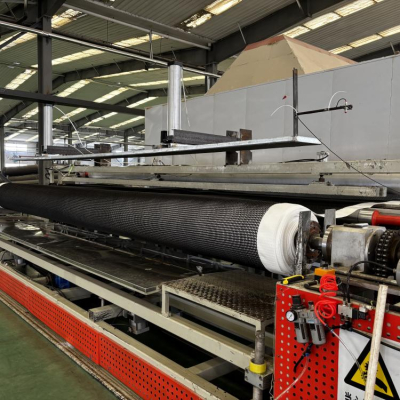
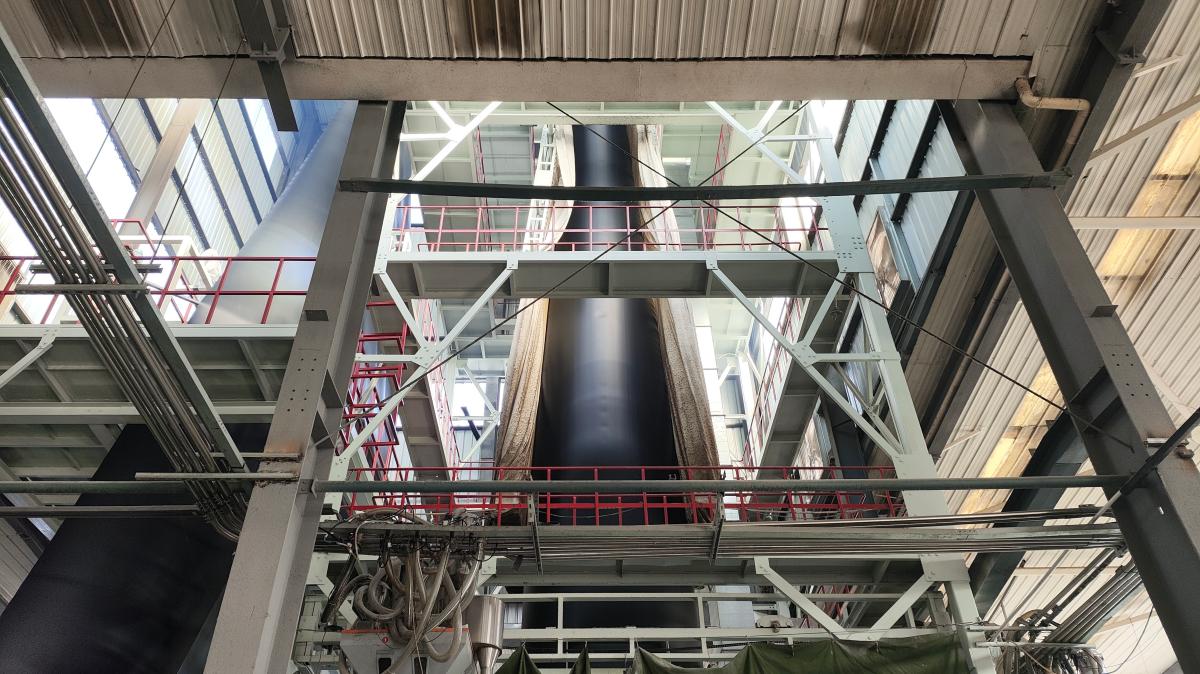
Making 2mm HDPE Liner is not like running a 0.5 mm pond liner. The extrusion die has to push molten polymer through carefully machined channels that keep pressure even across the width . After the die, a three-roll calendering system cools and flattens the sheet.
Modern lines use laser sensors to check thickness in real time. Good ones hold tolerance to ±0.05 mm — about 2.5 percent . Each production lot gets sampled and tested. A reputable HDPE geomembrane supplier will provide a Mill Test Report for every lot. If they won't, do not buy.
Real Projects That Used 2mm HDPE Liner
Volgermeerpolder Landfill Cap (Netherlands)
Between 2006 and 2010, Royal Boskalis Westminster installed 850,000 square meters of 2mm HDPE Liner to cap the old Volgermeerpolder dumpsite near Amsterdam . The site was heavily polluted. The job was to seal it off from the environment permanently.
That scale — nearly a million square meters — shows what 2mm HDPE Liner can do. It is not just for small ponds. It handles massive environmental remediation work.
Arizona Copper Mine Heap Leach
A copper mine in Arizona needed a liner for its heap leach pad . The solution was hot sulfuric acid. The subgrade was rough. The ore pile above would weigh tons.
They specified 2mm HDPE Liner. Thinner material would have cracked under the chemical stress or been punctured during placement. The 2mm HDPE Liner held up, kept the acid where it belonged, and kept the mine in compliance .
New GM13 Dam Liner (2025)
In late 2025, Shandong Haoyang launched a GM13-compliant 2mm HDPE Liner aimed at dam and reservoir projects . The specs: 29 kN/m tensile yield, 640 N puncture resistance, 50–100 year service life.
The launch matters because it shows that manufacturers are still investing in 2mm HDPE Liner technology. They see demand holding strong.
Where Else It Gets Used
Beyond those headline projects, 2mm HDPE Liner shows up in:
1.Hazardous waste landfill cells (primary liner)
2.Tailings storage facilities
3.Industrial chemical ponds
4.Power plant cooling water basins
Anywhere a leak would be a disaster, you will probably find 2mm HDPE Liner.
How to Pick a Good HDPE Geomembrane Supplier
What to Ask For
Not every HDPE geomembrane supplier delivers the same quality. Here is your checklist:
Certifications — GRI-GM13 or ASTM D7465. No exceptions.
Resin proof — 100 percent virgin resin from a name brand (Dow, ExxonMobil, Borealis). Recycled content has no place in a 2mm HDPE Liner for hazardous service.
Third-party test reports — SGS, TÜV, Intertek, or a GAI-LAP lab. In-house tests are fine, but outside validation is better.
Mill Test Reports — Lot-specific, not a generic certificate covering a whole quarter. The report should show actual numbers for thickness, tensile, puncture, carbon black, and OIT.
Warranty — 20 years is standard. If a supplier offers less, ask why.
Old references — Ask for landfill or mining jobs that are five years old or more. A liner looks good on a data sheet. Five years in the ground tells the truth.
Red Flags
Avoid any HDPE geomembrane supplier who:
Hesitates to share lot-specific test data
Quotes a price way below market with no explanation
Gives vague answers about where the resin comes from
Has no third-party certifications
Offers a short warranty or none at all
Installing 2mm HDPE Liner — Doing It Right
Subgrade Prep
The ground under a 2mm HDPE Liner must be smooth. No rocks over 12 mm. No roots. No sharp edges. Compact to at least 95 percent Proctor density. For rough sites, add a non-woven geotextile cushion (300–800 g/m²).
Welding
Dual-track thermal fusion welding is the standard. The seam area must be dry and clean. Dust or moisture will ruin the weld.
Testing
Every seam gets tested. Non-destructive methods (air pressure, vacuum) cover the whole length. Destructive samples — one per 300 meters — get pulled in a lab. If a contractor pushes back on testing, find another contractor.
Frequently Asked Questions
Q1: Do I really need 2mm HDPE Liner, or can I use 1.5mm?
It depends on the risk. For a municipal landfill, 1.5 mm might meet the regulation. For hazardous waste or a heap leach pad with hot acid, go with 2mm HDPE Liner. The extra thickness gives you 640 N puncture resistance (vs. 480 N for 1.5 mm) and 1,000+ hours stress crack resistance (vs. 300 hours minimum) . That margin matters.
Q2: How long will a 2mm HDPE Liner last?
Cover it properly, and you get 50–100 years . The Volgermeerpolder cap was installed over 15 years ago and is still doing its job. The key is a good antioxidant package and proper installation.
Q3: How do I check if a HDPE geomembrane supplier is selling certified 2mm HDPE Liner?
Ask for the GRI-GM13 certificate and a lot-specific Mill Test Report. Check that tensile yield is ≥29 kN/m, puncture ≥640 N, carbon black 2.0–3.0%, and stress crack ≥1,000 hours . If the numbers do not match, do not buy.
Q4: What is the real difference between 1.5mm and 2mm HDPE Liner?
Puncture resistance jumps from 480 N to 640 N. Stress crack resistance goes from 300 hours to 1,000+ hours . For a mining site or a hazardous waste cell, that difference is the line between a liner that lasts and one that fails early.
Q5: What does GRI-GM13 mean, and why should I care?
It is the industry standard for HDPE geomembranes used in containment . It sets minimum requirements for thickness, strength, puncture resistance, carbon black, and stress crack resistance. If your 2mm HDPE Liner is not GM13-certified, you have no guarantee it will perform.
Conclusion: Pay for What Works, Not Just What Is Cheap
The global market for 2mm HDPE Liner has plenty of options. The hard part is telling good material from bad. Price alone will not tell you.
The Volgermeerpolder project used 850,000 m² of 2mm HDPE Liner and it is still holding . The Arizona copper mine used 2mm HDPE Liner and avoided a leak that could have shut them down . The new GM13 liners on the market offer 50–100 year service lives .
Professional buyers do three things:
1.Write specs that call out GRI-GM13 or ASTM D7465
2.Demand lot-specific Mill Test Reports before any material ships
3.Work with a HDPE geomembrane supplier who provides test data, traceability, and real project references
The cheapest 2mm HDPE Liner is rarely the best deal. The best deal is the liner that does its job for decades.
Free Resource: We offer a 2mm HDPE Liner Specification Template and a Supplier Audit Checklist. Both are based on real project experience in mining, landfills, and water infrastructure.
Contact our technical team to review your specs, request Mill Test Reports, or discuss your next 2mm HDPE Liner project.