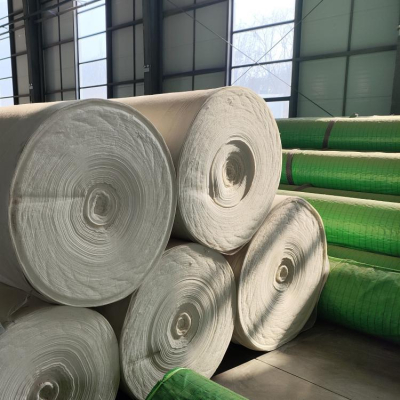
2mm Geomembrana: 2026 Market Review, Technical Standards, and Global Sourcing Guide
Introduction: Where 2mm Geomembrana Fits in Heavy-Duty Containment
When a project involves aggressive chemicals, steep slopes, or long-term environmental liability, engineers rarely gamble on thin materials. They reach for Geomembrana 2mm. This 80-mil HDPE liner balances the flexibility needed for installation against the brute strength required for decades of service.
The global market for HDPE Geo Membrane continues its steady climb. The broader geomembrane sector was worth about USD 2.89 billion in 2026 and should hit USD 4.62 billion by 2034, a 6.8 percent annual growth rate . Thicker products like 2 mm command higher prices — they use more resin and must pass stricter quality checks .
This report looks at the Geomembrana 2mm market in 2026: current pricing, technical specifications, real mining and landfill projects, and how to pick a reliable HDPE Geo Membrane supplier.
Market Overview — Pricing, Drivers, and Regional Differences
What You Will Pay for 2mm Geomembrana in 2026
Bulk pricing for smooth Geomembrana 2mm (ex-works) ranges from USD 2.00 to USD 3.50 per square meter . Textured versions add USD 0.50–1.00/m² because they need extra processing steps.
Regional price differences are significant and reflect local manufacturing capacity and regulatory demands:
| Region Price | Range (USD/m²) | Why the Difference? |
Asia-Pacific | 2.00–3.00 | Large-scale domestic production |
North America | 2.80–3.50 | GRI-GM13 compliance, third-party QA |
Middle East/Africa | 3.50–4.80 | Import costs, special UV additives |
Europe | 3.00–3.90 | CE marking, sustainability paperwork |
Orders over 50,000 m² typically qualify for volume discounts of 15–30 percent . Installed costs — welding labor, site prep, and QA/QC — add USD 0.50–3.00/m², or 20–50 percent of material cost, depending on how rough the terrain is and local wage rates.
 |  |  |
What Is Pushing Demand for 2mm Thickness
Mining Sector — Heap leach pads and tailings facilities are tough on liners. They see hot chemicals, heavy equipment traffic, and sustained stress. A copper mine in Arizona successfully used Geomembrana 2mm for its leach pad, where the solution was hot sulfuric acid .
Landfill Rules — Hazardous waste landfills often require 2.0 mm (80 mil) for primary liners. Municipal landfills can use 1.5 mm, but where the leachate is nasty, engineers go thicker .
Water Storage — Dam and reservoir projects now specify HDPE Geo Membrane in 2 mm thickness when the subgrade is rocky or future maintenance might puncture a thinner sheet.
Technical Specifications for Geomembrana 2mm
Material Makeup and Manufacturing
A genuine HDPE Geomembrane Sheet in 2 mm thickness starts with virgin HDPE resin, density between 0.94 and 0.96 g/cm³. Three additives are critical:
Carbon black (2.0–3.0%) for UV protection
Antioxidants to fight thermal aging
Process aids to keep sheet thickness uniform
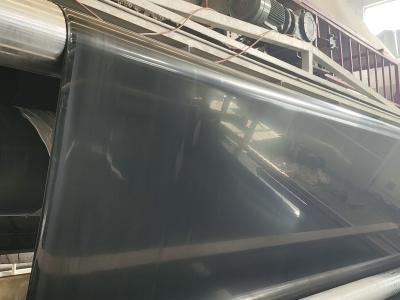
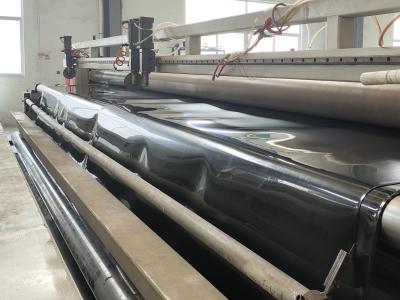
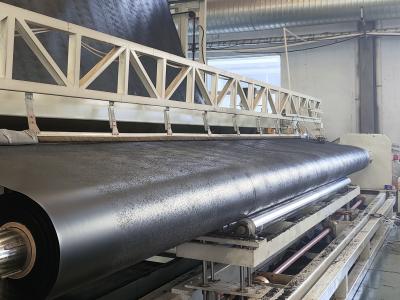
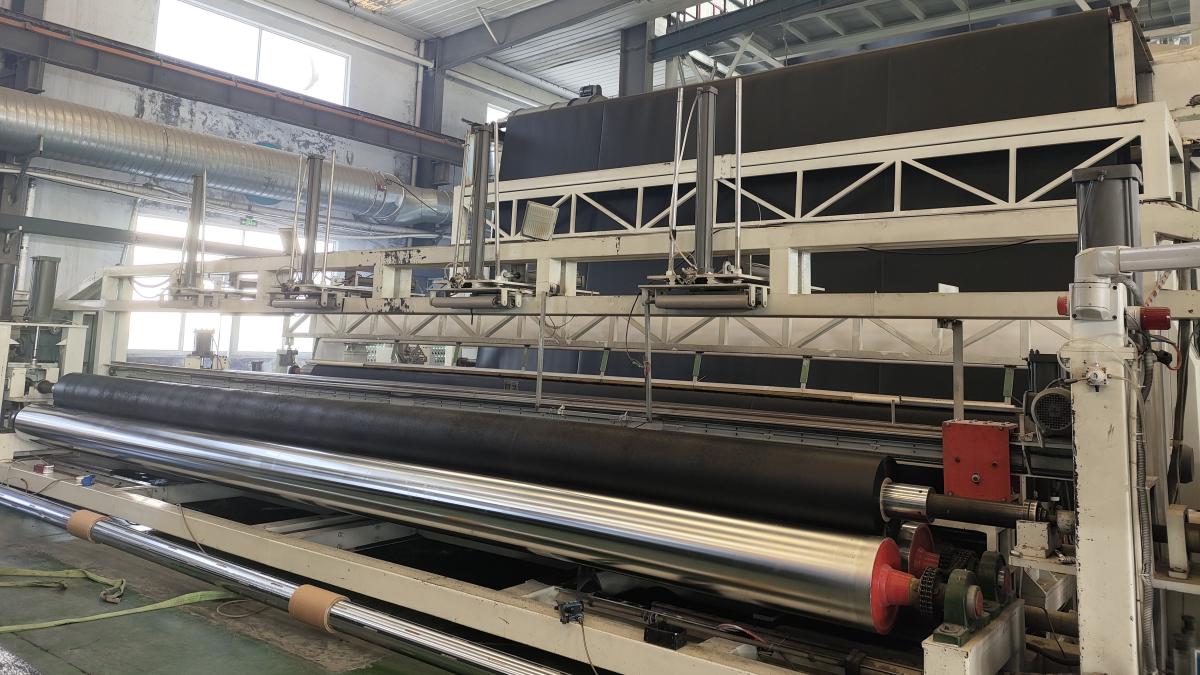
Most makers use three-layer co-extrusion or blown film lines. Resin gets heated to about 200°C, pushed through a die, then cooled on calibrated rollers to lock in the thickness .
To meet GRI-GM13 or ASTM standards, a HDPE Geo Membrane in 2 mm must hit these minimum numbers :
| Property | Requirement | Test Method |
| Density | ≥ 0.940 g/cm³ | ASTM D1505 |
| Tensile Yield (MD) | ≥ 29 kN/m | ASTM D6693 |
| Tensile Yield (TD) | ≥ 25 kN/m | ASTM D6693 |
| Elongation at Break | ≥ 700% | ASTM D6693 |
| Puncture Resistance | ≥ 640 N | ASTM D4833 |
| Tear Resistance | ≥ 249 N | ASTM D1004 |
| Stress Crack Resistance | ≥ 1,000 hours | ASTM D5397 |
| Carbon Black Content | 2.0–3.0% | ASTM D4218 |
| OIT (Std) | ≥ 100 min | ASTM D3895 |
A HDPE Geomembrane Sheet that meets these numbers will deliver 99.9 percent containment and, if buried or covered, last 50–100 years .
Why 2mm Beats Thinner Options
Compared to 1.5 mm, Geomembrana 2mm offers:
1.Higher puncture resistance: 640 N vs. 480 N
2.Better stress crack resistance: 1,000+ hours vs. 300 hours minimum
3.Stronger tensile yield: 29 kN/m vs. 22 kN/m — a 32 percent jump
For a heap leach pad handling hot acid, that extra margin is not a luxury. It is a necessity.
Real-World Projects Using 2mm Geomembrana
Myanmar Copper Mine Heap Leach (2023)
A copper mine in central Myanmar, about 110 km from Mandalay, needed a liner for its heap leach pad. The operation used wet smelting — heap leaching and electrowinning — to produce cathode copper. The site covered 32 square kilometers, with the Chindun River running along the eastern side .
The customer specified Geomembrana 2mm to GRI-GM13 standards. Key demands:
1.Resists acidic heavy metal solutions
2.Holds up under ore pile loads
3.Stops leachate from reaching groundwater
4.Allows leachate collection for copper recovery
The supplier delivered 500,000 square meters of HDPE Geo Membrane in 7 m x 100 m rolls, made with three-layer co-extrusion, carbon black, antioxidants, and UV stabilizers. The owner ran lab tests on all indicators and confirmed compliance with ASTM GM13 before ordering .
Outcome: The liner kept acidic solution out of the ground, protected local groundwater and the river, and let the mine collect leachate efficiently for copper recovery.
Arizona Copper Mine Heap Leach Pad
Another copper mine in Arizona used HDPE Geomembrane Sheet at 2 mm for its heap leach pad. The specification called for a liner that could handle both the high temperatures and the aggressive chemicals in the extraction process .
The material worked. It kept harmful chemicals out of nearby water sources, kept the mine in compliance, and protected local ecosystems.
Texas Landfill Project
A Texas landfill used 1.0 mm HDPE for standard municipal cells. But for the hazardous waste cells, Geomembrana 2mm was the spec. Higher risk demands thicker material. The job paid close attention to welding and seam strength — because seams are often the weak point in any liner system.
PFAS Research — A New Concern
A 2025 study in the Journal of Hazardous Materials Advances looked for PFAS in HDPE geomembranes . The researchers tested three different HDPE liners for six specific PFAS compounds and measured total fluorine.
What they found:
1.Perfluoropropionic acid (PFPrA), an ultra-short-chain PFAS, showed up in every liner tested
2.Levels ranged from below the limit of quantification to 0.44 µg/g
3.One factory's product had nearly ten times the PFPrA of another
4.Total fluorine for all samples was below reporting limits
What it means: The big differences between factories suggest PFPrA comes from polymer processing aids or additives, not from the resin itself. As regulations push toward PFAS-free processing aids, buyers should ask HDPE Geo Membrane suppliers exactly what is in their additive package.
Where 2mm Geomembrana Gets Used
Mining — Heap Leach and Tailings
Mining puts HDPE Geomembrane Sheet through the wringer: hot chemicals, heavy loads, long-term stress. The Myanmar and Arizona projects show Geomembrana 2mm can handle it.
Recommended specs:
1.Minimum thickness: 2.0 mm
2.Textured surface for slopes over 3H:1V
3.Stress crack resistance ≥ 1,000 hours
Hazardous Waste Landfills
Hazardous waste cells need thicker liners than municipal sites. Geomembrana 2mm provides:
1.Higher puncture resistance (640 N) for sharp waste and heavy equipment
2.Better chemical resistance for aggressive leachate
3.Longer service life in tough conditions
Dam and Reservoir Lining
Water conservancy projects are specifying HDPE Geo Membrane at 2 mm for dam faces and reservoir bottoms. The permeability coefficient (K ≤ 1.0 × 10⁻¹¹ cm/s) makes it excellent for cutting water loss.
Industrial Ponds
Chemical plants and wastewater facilities use Geomembrana 2mm for secondary containment of hazardous by-products. The material's low permeability and chemical stability provide long-term groundwater protection.
How to Pick a Supplier for HDPE Geo Membrane
Your Supplier Checklist
When evaluating HDPE Geo Membrane suppliers, check these boxes:
Certifications — GRI-GM13 or ASTM compliance, backed by third-party labs. The Myanmar project required GM13 certification before they would place the order .
Resin Traceability — 100 percent virgin resin from a name brand (Dow, ExxonMobil, Borealis). Recycled material has no place in Geomembrana 2mm for hazardous service.
Mill Test Reports — Lot-specific, not a generic certificate covering a whole quarter. The report should show actual numbers for thickness, tensile, puncture, carbon black, and OIT
Production Capacity — Can they make enough to meet your schedule? For orders over 100,000 m², this matters.
Warranty — 20 years minimum for HDPE Geomembrane Sheet that meets GRI-GM13.
Red Flags
Avoid any HDPE Geo Membrane supplier who:
Hesitates to share lot-specific test data
Quotes under USD 2.00/m² without a good explanation
Gives vague answers about resin sources
Has no third-party certifications
Offers a short warranty or none at all
Installing 2mm Geomembrana — Getting It Right
Subgrade Prep
The ground under a Geomembrana 2mm must be smooth. No rocks over 12 mm. No roots. No sharp edges. Compact to at least 95 percent Proctor density. For rough sites, add a non-woven geotextile cushion (600–800 g/m²).
Welding
Dual-track thermal fusion welding is the standard for HDPE Geo Membrane. The seam area must be dry and clean. Dust or moisture will ruin the weld. Use extrusion welding for patches and details .
Testing
Test every seam. Non-destructive methods (air pressure, vacuum) cover the whole length. Destructive samples — one per 300 meters — get pulled in a lab. Run trial welds at the start of each shift and after every four hours of welding.
The copper mining projects proved that good QA/QC during installation is just as important as good material .
Frequently Asked Questions
Q1: What is the typical price for Geomembrana 2mm in 2026?
Bulk pricing for smooth Geomembrana 2mm runs USD 2.00 to USD 3.50 per square meter (ex-works). Texture adds USD 0.50–1.00/m². Installed cost adds another USD 0.50–3.00/m² .
Q2: How long will a 2mm HDPE Geo Membrane last?
If properly made, installed, and covered, HDPE Geo Membrane at 2 mm lasts 50–100 years . It keeps ≥65 percent of its original strength after 1,600 hours of UV exposure . Exposed installations last less time, depending on UV intensity and local climate.
Q3: What is the difference between 1.5mm and 2mm Geomembrana?
Geomembrana 2mm gives you: puncture resistance 640 N vs. 480 N; tensile yield 29 kN/m vs. 22 kN/m; stress crack resistance 1,000+ hours vs. 300 hours . For mining and hazardous waste, that extra margin is critical.
Q4: What certifications should I require for HDPE Geomembrane Sheet?
Require GRI-GM13 or ASTM D7176 certification with lot-specific Mill Test Reports. Verify: density ≥0.940 g/cm³, tensile yield ≥29 kN/m, puncture ≥640 N, carbon black 2.0–3.0%, stress crack ≥1,000 hours .
Q5: Are there PFAS concerns with HDPE geomembranes?
A 2025 study found PFPrA (an ultra-short-chain PFAS) in all tested HDPE liners, but levels varied widely between factories . Buyers concerned about PFAS should ask suppliers about their processing aid formulations and consider independent lab testing.
Conclusion: Pay for What Works, Not Just What Is Cheap
The global market for Geomembrana 2mm has plenty of options. The hard part is telling good material from bad. Price alone will not tell you.
Real projects show what works: the Myanmar copper mine used 500,000 m² of HDPE Geo Membrane with GM13 certification ; the Arizona mine needed 2 mm to handle hot acid ; and new PFAS research may change how we specify liners in the future .
Professional buyers do three things:
1.Write specs that call out GRI-GM13 or ASTM D7176
2.Demand lot-specific Mill Test Reports before any material ships
3.Work with HDPE Geo Membrane suppliers who provide test data, traceability, and real project references
The cheapest Geomembrana 2mm is rarely the best deal. The best deal is the liner that does its job for decades.
Free Resource: We offer a 2mm Geomembrana Technical Specification Template and a Supplier Audit Checklist. Both are based on real project experience in mining, landfills, and water infrastructure.
Contact our technical team to review your specs, request Mill Test Reports, or discuss your next HDPE Geomembrane Sheet inquiry.