
Beyond the Simple Filter: Strategic Sourcing of Geotextile Drainage Fabric in an Era of Stricter Standardse
We are encountering a stubborn reality in the field. Project engineers in Northern Europe and North America report that nearly 18% of all infrastructure repair callbacks within the 5-10 year window are linked to subsurface water management failures. Often, the specified Geotextile Drainage Fabric met initial roll specifications but failed under sustained hydraulic loading, leading to clogging or insufficient flow capacity. For procurement specialists and civil engineers, the gap between a product's data sheet and its three-decade field performance has become the central challenge. Navigating this requires more than a catalogue selection; it demands an understanding of an evolving technical and regulatory landscape. It compels a shift from sourcing a generic material to engineering a site-specific hydraulic solution.
 |  |  |
The Market Calculus: Why Global Infrastructure Demands Are Redefining Performance Benchmarks
Market forecasts consistently highlight growth, but the granular data reveals a more telling story. A recent analysis for the Asian Development Bank indicated that while overall demand for geosynthetics grows at 5.5%, the segment for high-performance drainage composites—which integrate a robust Geotextile Filter Fabric—is expanding at over 14% annually. This divergence is not accidental.
Two primary forces are at play. First, the actuarial models of global reinsurance firms now explicitly factor in climate resilience. Projects in flood-prone areas or with high water tables must demonstrate engineered water management solutions, making the long-term certified performance of the Geotextile Drainage Fabric a financial risk mitigant, not just a technical item. Second, the rise of performance-based contracting, especially in Public-Private Partnerships, ties concession revenue directly to asset longevity. A road’s sub-base drainage system, dependent on a functional Geotextile Membrane composite, cannot be a weak link. The procurement focus has irrevocably shifted from upfront unit cost to the total cost of failure over a 25-year asset life.
Technical Specifications Decoded: The Three Pillars of Drainage Fabric Performance
To move beyond generic terms, buyers must dissect three core performance pillars that define a modern drainage geotextile.
1. Filtration Precision, Not Just Pore Size
The primary role of the Geotextile Filter Fabric is not merely to let water pass. Its critical function is to stabilize the soil interface. This is governed by its pore size distribution and thickness. Engineers must analyze the soil's grain size curve (particularly the D85) to specify the Apparent Opening Size. However, the new frontier is in dynamic clogging resistance. Premium fabrics undergo prolonged gradient ratio testing under site-specific soil and hydraulic conditions to provide a certified long-term flow reduction factor. A product might be labeled as a Geotextile Drainage Fabric, but its value lies in the manufacturer's guarantee that it will maintain 80% of its flow capacity after 25 years under your project's specific silt load.
2. Transmissivity Under Load: The True Measure of Flow
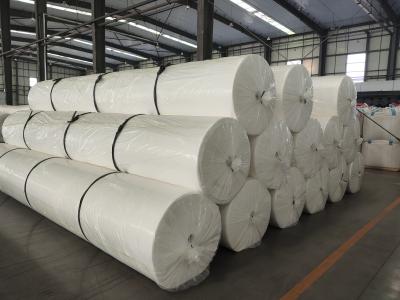
Many standard nonwovens offer minimal in-plane flow. A true drainage fabric must provide quantifiable transmissivity—the rate of water flow within its plane under a given normal stress. This is where composite systems shine. A high-flow geonet or cuspated core is laminated between two layers of Geotextile Filter Fabric. The resulting Geotextile Membrane acts as a unified drainage conduit. The key specification is the design transmissivity (θ_des), calculated by applying reduction factors for creep, intrusion, and clogging to the initial test value. For slope or wall applications, verifying this number under the expected confining pressure is non-negotiable.
3. Survivability and Installation Integrity
A fabric that performs perfectly in the lab is useless if it degrades on-site or is damaged during installation. Key here are the index properties: tensile strength, CBR puncture resistance, and UV stability. For a Geotextile Drainage Fabric exposed during construction, the UV resistance rating (e.g., 500 hours per ASTM D4355 with less than 50% strength loss) is a direct indicator of its installation window robustness. Furthermore, the seam strength of composite panels, often overlooked, must be validated to ensure the Geotextile Membrane functions as a continuous system.
Strategic Procurement in a Globalized Supply Chain
Given these technical complexities, a structured procurement approach is essential.
1.Audit the Manufacturer's QC, Not Just the Product: Request documentation of their Statistical Process Control for key variables like needlepunch density and polymer mix consistency. Inquire about their in-house testing lab's accreditation. The ability to provide batch-specific test reports for every shipment of Geotextile Filter Fabric is a mark of a serious producer.
2.Demand Application Engineering Support: A credible supplier will have civil engineers on staff who can review your borehole logs and drainage design. They should be able to model the required transmissivity and recommend a specific Geotextile Drainage Fabric composite, not just send a standard price list.
3.Factor in Logistics and Compliance: For cross-border shipments, ensure the supplier provides fully aligned documentation—commercial invoices, packing lists, and Mill Test Reports that match the Harmonized System codes of the destination country. Delays at customs due to paperwork discrepancies can dwarf any marginal savings on the fabric itself.
FAQ: The Critical Questions Experienced Buyers Are Asking
Q1: Our project involves a soil with a high fines content (silt and clay). How do we prevent the drainage fabric from blinding?
This is a classic challenge. For such soils, the standard filtration criteria may not be sufficient. You need a fabric designed for "critical" or "stable" filtration. This typically involves specifying a relatively thick, nonwoven Geotextile Filter Fabric with a small enough AOS to prevent particle migration, but with high permeability to allow water passage. More importantly, you must request the manufacturer’s specific test data for gradient ratio performance with a soil similar to yours. A premium Geotextile Drainage Fabric for fine soils will have passed long-term filtration tests demonstrating non-clogging behavior.
Q2: What are the practical trade-offs between a thick needle-punched nonwoven and a composite drainage board with a geotextile skin?
This choice hinges on the required flow rate and the available space. A thick, heavyweight nonwoven can provide moderate in-plane drainage and excellent filtration for many applications, like behind retaining walls. However, for applications requiring high-volume water removal—such as under a plaza deck, in a landfill cap, or for a sports field sub-base—a composite is mandatory. A drainage board with a cuspated HDPE core laminated to a Geotextile Membrane offers orders of magnitude higher transmissivity in a slim profile. The composite is the engineered solution for high-flow scenarios.
Q3: How do we verify the long-term chemical compatibility of the fabric for a landfill leachate collection layer or an industrial site?
Do not rely on generic chemical resistance charts. Provide the supplier with a detailed chemical analysis of the expected leachate or effluent. They should then perform, or provide existing data from, an immersion test per ASTM D5322 or similar. For a Geotextile Drainage Fabric in aggressive environments, the stability of the polymer (usually polypropylene) is generally good, but the performance of the antioxidants and UV stabilizers in the chemical soup is critical. Request a manufacturer's letter of conformance stating the fabric's suitability for your specific chemical exposure profile.
A Call for Collaborative Specification
The days of treating drainage fabric as a low-bid commodity are a significant liability. The convergence of extended warranties, climate adaptation mandates, and forensic failure analysis means the specified Geotextile Drainage Fabric is a permanent part of the project's legal and performance record.
Initiate a technical review before your next tender.
Forward your project's geotechnical summary and drainage design details to our engineering team. In return, you will receive a Drainage Fabric Performance Audit—a no-cost analysis that benchmarks our recommended Geotextile Membrane composite against standard alternatives, using your specific soil and hydraulic data to project long-term performance and total cost of ownership.
Protect your project’s integrity from the ground up. Specify with certainty.


